
Written By:
The Impulse Team
You know strength training is probably something you should be doing.
But knowing that and knowing where to start are two very different things.
How many days a week should you train? What exercises should you do? How heavy should you lift? What if you don't even know half the exercises yet?
It can feel like there's a lot to figure out before you ever pick up a weight.
The good news is that strength training doesn't need to be complicated.
You don't need the perfect workout, fancy equipment, or years of experience. You need a good starting point, a plan you can follow, and enough consistency to give your body time to adapt.
Here's where we'd start.
Start With 2–3 Strength Training Sessions Per Week
If you're new to strength training, more isn't necessarily better.
For most beginners, training 2–3 times per week is a great place to start. It gives you enough practice and consistency to make progress while still allowing time to recover between workouts.
The goal isn't to see how much exercise you can fit into one week.
It's to create a routine you can actually maintain.
Two consistent workouts every week will take you much further than five workouts one week followed by two weeks of doing nothing because you're exhausted or sore.
As you get stronger and more experienced, your training can evolve with you.
Focus on the Basics
You don't need dozens of exercises to build strength.
A good beginner strength program will usually include basic movement patterns such as:
- Squatting
- Hinging at the hips
- Pushing
- Pulling
- Carrying
- Moving through different ranges of motion
Those movements can look very different depending on the person.
A squat might mean a bodyweight squat for one person, a goblet squat for another, or a different variation entirely for someone working around a limitation.
That's an important part of strength training: the exercise should meet you where you are.
You don't have to force yourself into an exercise just because you've seen someone else doing it.
Don't Worry About Lifting Heavy Right Away
One of the biggest questions beginners have is:
How heavy should I lift?
Heavy enough that the exercise challenges you—but not so heavy that you can't perform the movement with control.
When you're starting out, learning how to perform exercises well matters more than chasing a number on the dumbbell.
You can gradually add weight, repetitions, range of motion, or difficulty as you become stronger.
That's called progressive overload, and it's one of the basic principles behind getting stronger over time.
You don't have to rush it.
Strength and Mobility Don't Have to Be Separate Goals
There's a common idea that strength training makes you tight, while stretching or something like yoga is what you need to stay flexible and mobile.
But strength and mobility don't have to work against each other.
When strength training is programmed well, you can build strength while also training your body through useful ranges of motion.
That might mean gradually improving how comfortably you squat, strengthening your shoulders through an appropriate range, or developing better strength and control around your hips.
Mobility isn't just about how far you can stretch. Being able to control and use your range of motion matters too.
That's why the way you strength train matters.
The goal isn't just to lift more weight.
It's to build a body that is strong, capable, and able to move well.
Don't Make Every Workout Random
When you're new to strength training, it's easy to choose exercises based on something you saw online, what someone else at the gym is doing, or simply whatever sounds good that day.
That's still movement—but it makes progress harder to measure.
A structured program gives you something to build on.
You can repeat important movements, track what you're doing, gradually increase the challenge, and make adjustments as you improve.
Instead of asking:
“What should I do today?”
you walk into the gym knowing there's a reason behind what you're doing.
If you want to understand this more, read Why Structured Workout Programming Beats Just Doing Random Exercises.
Give Yourself Time to Be a Beginner
This one matters.
You aren't supposed to know everything when you're starting.
You may not know what weight to choose. An exercise might feel awkward the first few times. You might not even recognize some of the exercises in a workout yet.
That's normal.
Strength training is a skill, and skills get better with practice.
The goal of your first few weeks isn't to prove how fit you are.
It's to learn, build confidence, and establish consistency.
If you're returning after a long break rather than starting for the first time, you may also want to read How To Get Back Into Workouts After A Break.
You Don't Have to Figure It Out Alone
You absolutely can learn to strength train on your own.
But you also don't get bonus points for figuring everything out the hard way.
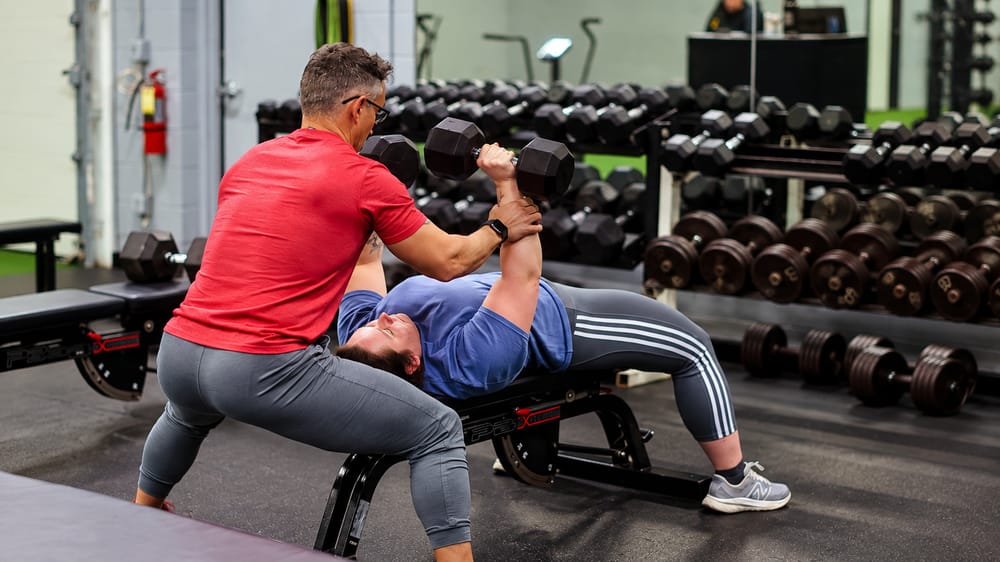
A good coach can help you learn exercises, choose appropriate starting points, adjust movements when necessary, and follow a program that progresses as you do.
At Impulse Training, our IMPACT semi-private training gives you personalized coaching in a small-group setting with no more than six people per session.
You get a structured program and a coach there to guide you—without having to navigate strength training alone.
The Best Place to Start Is Where You Are
You don't need to get stronger before you start strength training.
You don't need to lose weight first.
And you definitely don't need to know every exercise before you begin.
Start with a couple of days each week. Learn the basic movements. Use weights you can control. Follow a plan. Give yourself time to improve.
Then keep showing up.
Strength is built gradually—and the most important thing you can do as a beginner is simply give yourself a place to start.
Ready to Start Strength Training?
If you'd like some help getting started, come experience Impulse Training in North Canton, Ohio.
Your first training session is on us.
You'll meet our team, experience our coaching, and get a feel for what training at Impulse can look like for you.

At Impulse Training, we believe fitness is about more than just working out. It's about building strength, moving better, and staying capable for the things you want to do in life.
With expert coaching and a supportive community, we'll meet you where you are and help you keep moving forward.
YOUR FIRST SESSION IS ON US
Come Experience Impulse Training
Not sure where to start? Come train with us.
Meet our team, experience our coaching, and see what training at Impulse can look like for you.
Hours
Monday – Thursday:
5am – 10am
4pm - 8pm
Friday: 5am – 10am
Saturday: 6am – 11am
Closed Sunday
Class Schedule
©2025 All rights reserved